References

Nile City - Cairo

EGYPT, 1998-1999

Retaining wall and foundations for 36-storey property with four basement levels.


The twin 150m-high towers of the riverside Nile City complex on the Nile in North Cairo will house offices, apartments, a business centre, cinemas and a shopping mall, with four basements levels for parking and services.

The difficult geology at the site called for a range of specialist construction techniques, provided by SBE under separate and joint contracts.

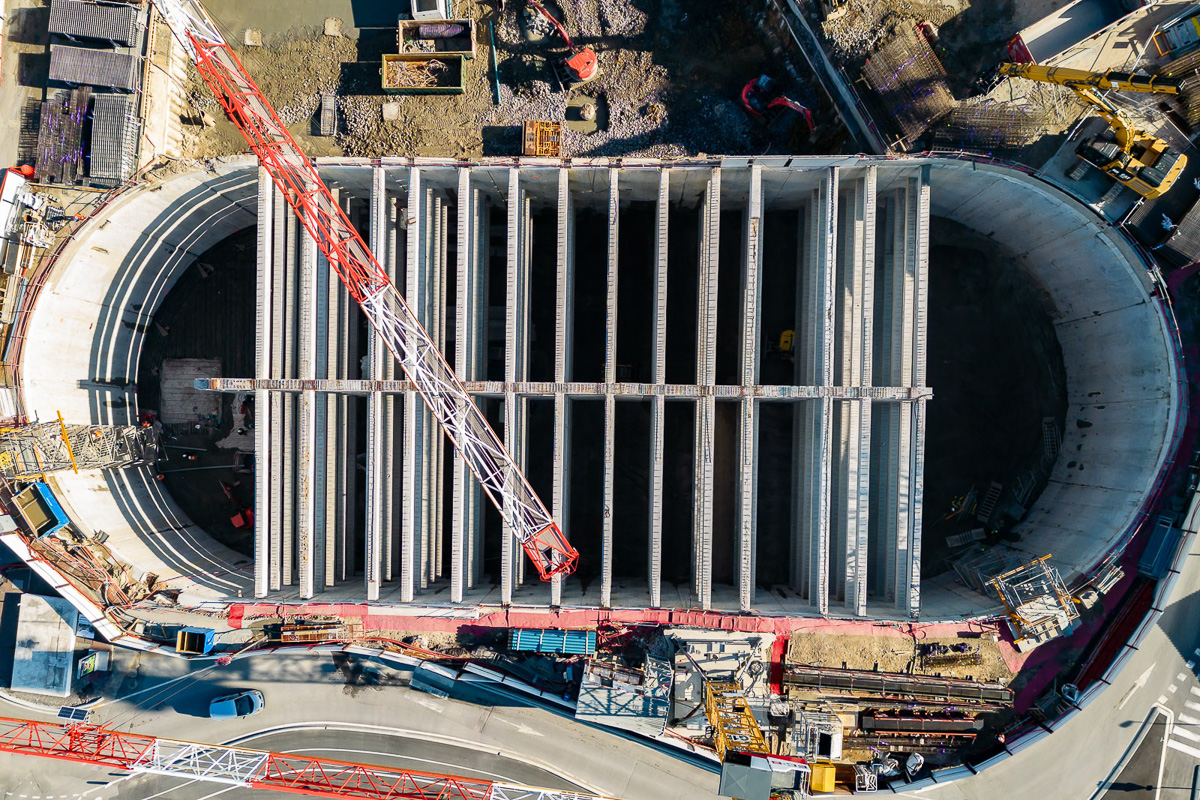
The specialist works required comprised the excavation of a 16,000 m2 area to a depth of 14m, and deep foundations for the towers and other structures.

The ground conditions (water table 4m below surface) and great thickness of alternating sands and clays called for the following works:
• Construction of a peripheral diaphragm wall to a depth of 30m to reduce the pumpage requirement for dewatering the excavation. The wall was tied back with a double bank of ground anchors. The trench was dug by hammer grab. All joints were fitted with full-height double water stops (CWS process).
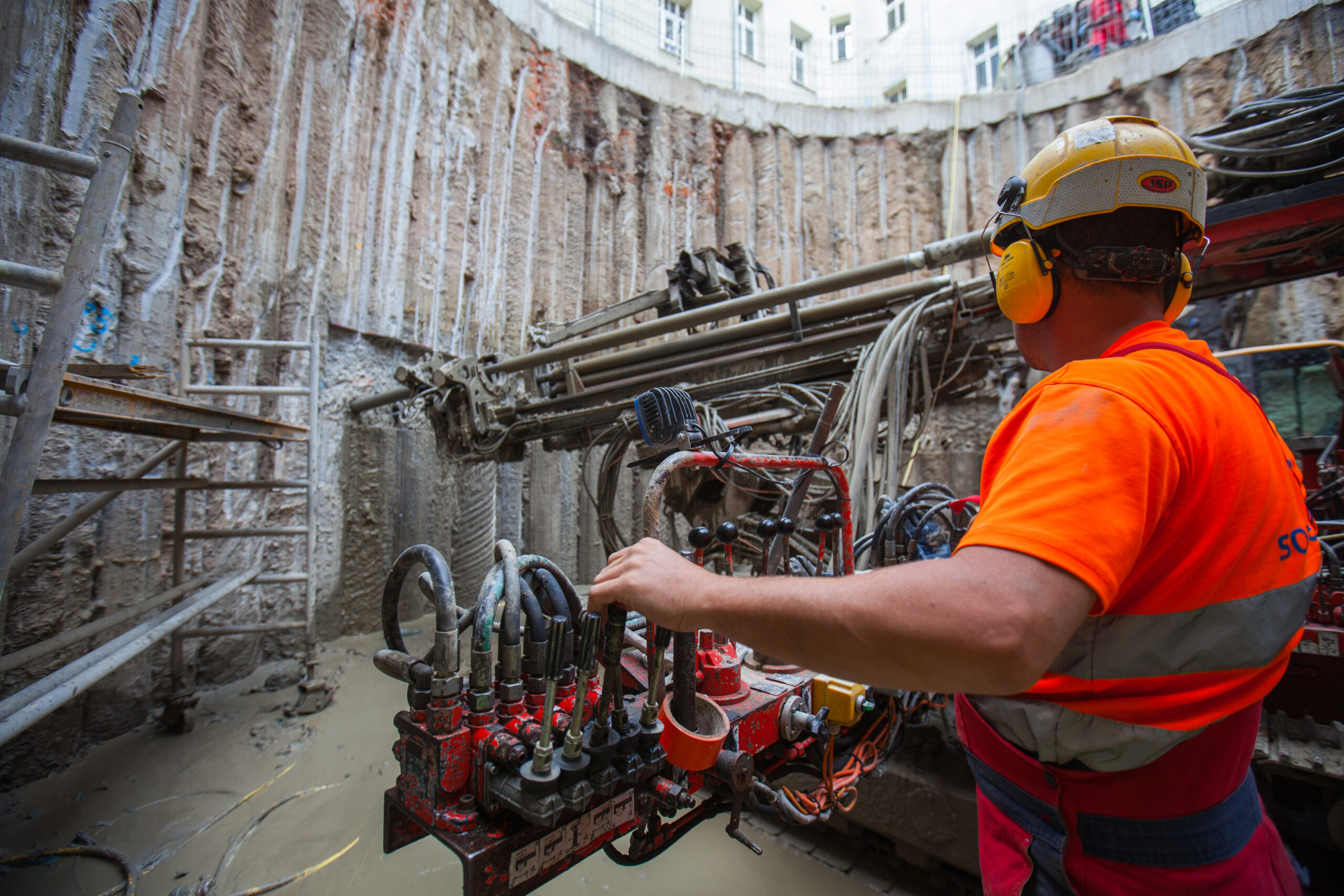
• Installation of 484 ground anchors in two banks, the second bank 6m below the water table was drilled under pressure.
• Construction of building substructure. The very high loads applied by the towers were transmitted to flat and tee barrette piles, isolated or combined in elements under the cores of the two towers.

The strict construction tolerances on these supports, the fast work rates dictated by the tight schedule and the special geotechnical features meant that the Hydrofraise 4000 had to be assigned. The substructure elements, built from ground level, were 41m deep and concreted over a height of 27m.

The less heavy structures sit on 1.00m and 1.20m bored piles reaching a depth of 38 metres.

Productivity driven by the tight schedule for the foundation works peaked at 800 m3 per day with as much material to be removed, and three concrete plants allowed the concreting rate to reach 500 m3 per day.

All the work was fully monitored:
- All diaphragm walling and barrettes were checked for thickness and tilt with Kodesol ultrasound apparatus
- A combination of systematic Kodesol tests and the Enpafraise continuous monitoring system made it possible to meet the stringent verticality requirements in the specifications, limiting tilt to 0.75% at 40m depth.

Several prior loading tests were made on the barrette piles up to 3000t with a tied-back beam reaction system.

A350.pdf


Techniques

Diaphragm wall

A diaphragm wall is a reinforced concrete wall that is made in situ. The trench is prevented from collapsing during excavation, reinforcing and casting by the use of supporting bentonite slurry. The slurry forms a thick deposit (the cake) on the walls of the trench which balances the inward hydraulic forces and prevents water flow into the trench. A slurry made of polymers can also be used.

Ground anchors

A ground anchor is a load transfer system designed to transfer the forces applied to it to a competent stratum. An anchor is said to be temporary if it has a lifespan of under two years and permanent if the lifespan is over two years.

Piles and micropiles

A pile is a structural element driven into the soil for transferring loads and prevent deformation. Its slenderness ratio is not limited.
Pile shafts can be uniform and rectilinear, telescopic and belled out.
Piles can be installed either separately or in groups. They can also form a retaining wall, a mixed curtain wall, contiguous piles, secant piles and composite curtain walls, such as Berlin walls and similar. Piles are also used as precast beams to be placed in the structure of the building they support.

Ouvrages

Building

Suitable foundations are required for all building and civil engineering structures to ensure that they perform within the settlement criteria established in the design of the structure. Special foundations are used where shallow footings do not provide adequate support for a structure.

Urban excavations

Major urban excavations are one of the specialist activities of Soletanche Bachy. Such excavations are required for basements to buildings that are usually part of the foundations of the structure and also used for under-street car parks, cut and cover tunnels for roads, rail, metro and storm water tank...


Voyage au coeur de l'ingénierie de pointe

Find out more about our expertise by: